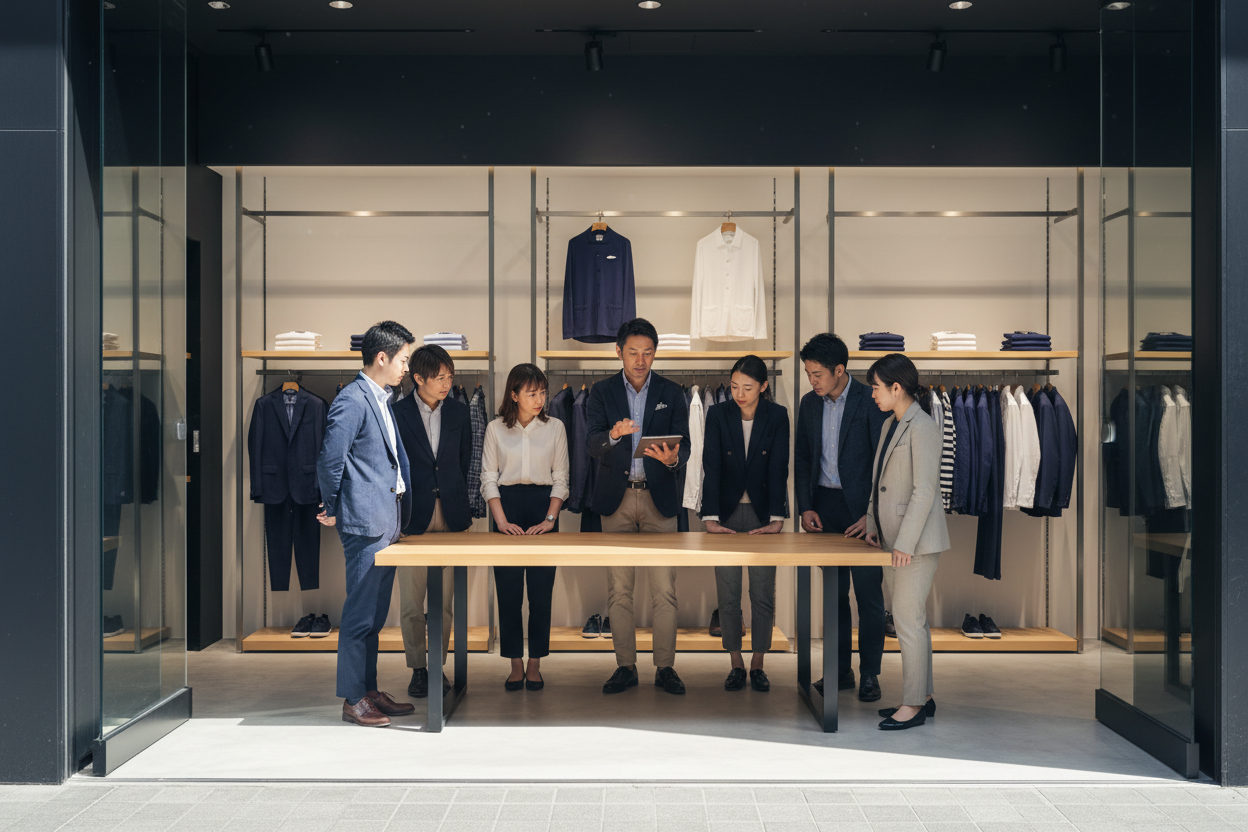
The most expensive employee in retail is not the CEO.
It is the store manager.
Not because their salary is the highest.
Because their decisions determine the economic output of the entire store.
Retail leaders spend enormous time controlling labor costs.
Schedules are optimized.
Staff hours are monitored.
Part-time ratios are adjusted.
Every hour of payroll is scrutinized.
Yet the single role that influences the economic performance of the store most directly is rarely discussed in these terms.
The Hidden Economics of Store Management
Consider a typical specialty retail store.
Annual sales may range between ¥200 million and ¥500 million.
The store manager earns perhaps ¥6–8 million per year.
On paper, the manager represents a small fraction of the store’s operating cost.
But that framing is misleading.
Every day, the store manager makes dozens of decisions that influence revenue:
- How staff are positioned on the floor
- When to push a promotion
- How to react to slow traffic
- How aggressively to approach customers
- How to handle inventory gaps
- How to adjust during weather changes
- How to run the morning meeting
None of these decisions appear in a financial statement.
But together they determine whether the store hits its sales target.
The store manager is effectively controlling the performance of hundreds of millions of yen in revenue.
Very few roles in the company carry that level of operational leverage.
The Decision Burden Problem
Despite this responsibility, most store managers operate with very limited decision support.
Retail organizations typically provide:
- sales reports
- KPI dashboards
- weekly targets
- spreadsheets from head office
These tools create visibility.
But they do not reduce the decision burden.
To translate data into action, the manager must still:
- Notice the problem
- Diagnose the cause
- Decide what to do
- Communicate it to the team
- Execute quickly on the floor
This entire process is happening in real time.
Often while helping customers.
Often with incomplete information.
Often while supervising a team that is already stretched.
Retail companies have built systems that report performance.
But they have rarely built systems that support daily decision making.
The Execution Gap
This creates what might be called the execution gap.
Head office defines strategy.
Dashboards show performance.
But the moment that actually determines results happens inside the store.
At 10:30 in the morning when traffic is slow.
At 2:00 in the afternoon when a promotion begins.
At 6:00 in the evening when staffing becomes tight.
In these moments, the store manager’s decisions determine what happens next.
Two stores with identical products, identical pricing, and identical traffic can produce very different results.
The difference is rarely the dashboard.
It is the quality and consistency of decisions made on the floor.
The Scale Effect Most Retailers Underestimate
The economic importance of store managers becomes even more significant when viewed at scale.
A single strong manager can dramatically improve the performance of one store.
A weak manager can drag another store down.
But most retail organizations operate dozens or hundreds of locations.
Across a network of stores, the performance distribution of managers tends to follow a familiar pattern.
A small number of managers consistently outperform.
A large group perform adequately.
And a smaller group struggle.
This is a classic Pareto distribution.
Twenty percent of managers often drive a disproportionate share of store-level performance.
The challenge is that strong managers do not scale easily. Their instincts, experience, and operational discipline are difficult to replicate across the network.
As a result, two stores with identical conditions can produce very different outcomes simply because the decision quality of the manager differs.
This creates a structural constraint on retail growth.
Adding more stores does not automatically add more strong managers.
Standardizing Decision Quality
If retail performance depends heavily on store-level decision making, the real opportunity is not just improving one manager.
It is improving decision quality across the entire network.
When hundreds of store managers are making dozens of operational decisions every day, small improvements compound rapidly.
A slightly better reaction to slow traffic.
More consistent morning alignment with staff.
Faster response to unexpected demand.
Individually these changes may seem small.
But multiplied across:
50 stores
100 stores
300 stores
the economic impact becomes substantial.
Strong managers will always outperform.
But improving the middle of the distribution often produces the greatest overall impact.
This is why decision support systems matter.
They do not replace managers.
But they can elevate the baseline decision quality across the organization.
Retail Performance Is a Decision System
Retail performance is often discussed in terms of product, pricing, and marketing.
Those factors matter.
But once the store opens, performance is largely driven by decisions made in real time.
The store manager sits at the center of that system.
Understanding this changes how we think about retail technology.
Instead of asking how systems can report performance, we should also ask how systems can support better decisions during the day.
Because the most expensive employee in retail is not the one with the highest salary.
It is the one whose decisions determine the outcome of the entire store.